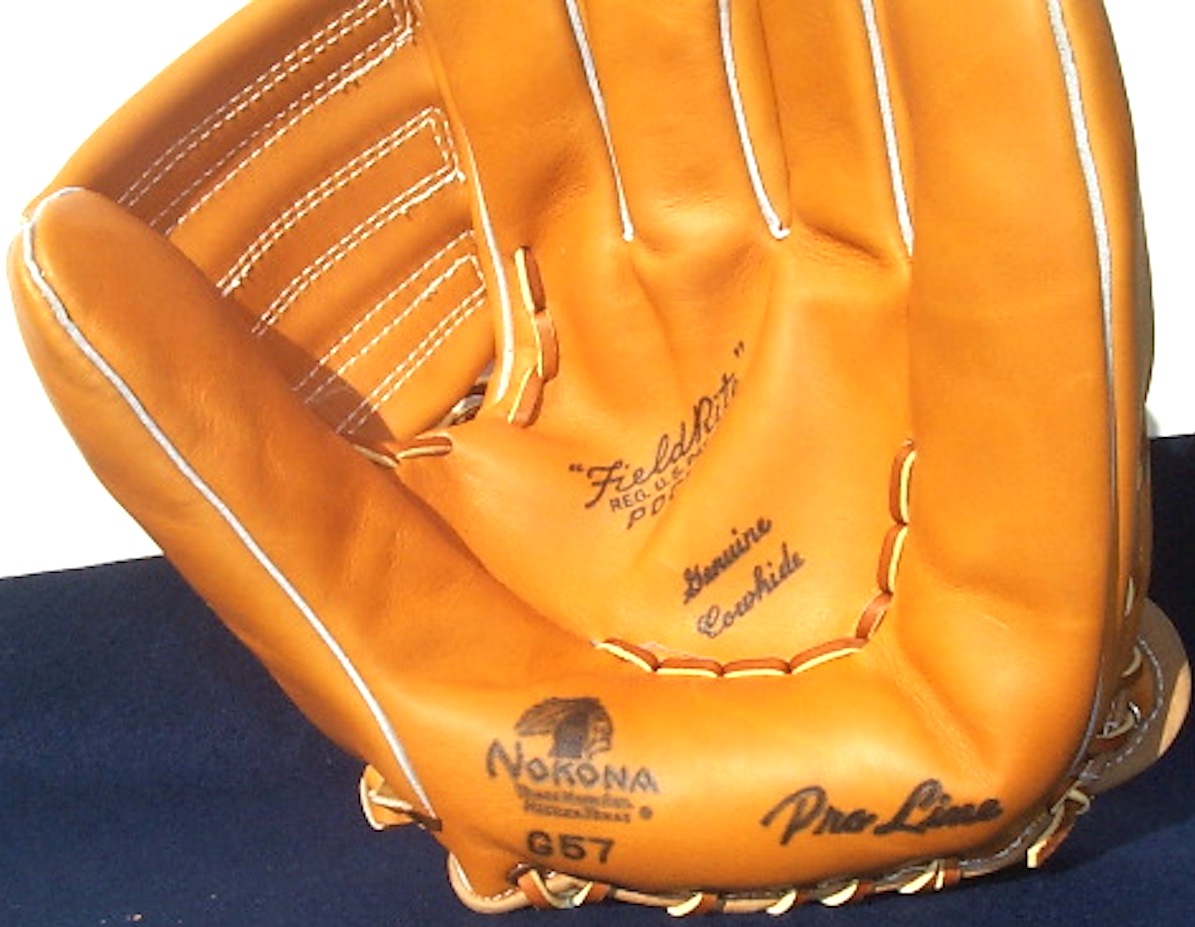
A sale on ebay that’s been up for over a year carries some mint and mint in the box gloves that we determined came from 1980s sale of gloves from a store or warehouse in Baltimore. That sale resulted in a Glove Collectors Book being produced by Jim Mace, son of a doctor who had purchased many of these gloves. I think we estimated that there may have been easily more than one hundred gloves and many with their boxes. Collector John Graham and I got a “sniff” of these at the 1991 Sports Collectors National held in Dallas. A lawyer in Fort Worth had purchased them from the original sale and had about 30 of these gloves on his table. John and I got busy buying some. I still have my mint Eddie Miller MacGregor Goldsmith glove from that purchase.
We thought, at the time, this would be it for a large lot of near mint to mint gloves and boxes up for sale.
This turned out to be the second largest of this type.
I had a couple of leads on mint “warehouse” gloves existing in Kansas somewhere from a Nocona rep who worked out of Kansas at one time saying that a former employer of his had stored some gloves in a warehouse. Months later some of the gloves actually showed up in our giant East Texas flea market in Canton Texas. (“found, the story goes, in a yard sale in Wichita, Kansas.”) Weeks later a phone call resulted in us finding a gentleman Frank Wolfe, former owner of the Wichita Sporting Goods. To make the story short Mr. Wolfe hadn’t paid his rent on his storage of some 400 gloves and the Warehouse owner had taken over the property. We contacted the owner and Dave Bushing and I purchased the 400 plus gloves, divided them and had a heck-of-a glove sale for about six months shortly thereafter. Seeing all those gloves at one time sort of took our breath away. One glover who came by got a glance and said “well I just died and went to heaven!”
As we mosey on down the road some 20 years later, nothing like these two sales has emerged, not even from the TV show “Locker Wars.” But, there’s always that hope. Near mint and mint gloves still demand the best prices on ebay and this is true for virtually all antiques and collectibles.
The Baltimore find released many late 1930s early 1940s gloves and the Kansas Sale mostly 50s gloves. There might have been a total of 600 gloves combined from both sales. Some of these seem to drift by the ebay stream from time to time. A smaller sale of dozens of gloves “Em-Jays” wound up in the hands of Collector Dan Creed in Chattanooga. It seems these came from North or South Carolina. Dan still collects gloves today.
Oddly a year before the Kanas find I purchased 30 mint and mint in the box gloves including a couple of Mickey Mantle gloves from the just closed Potchernik Sporting Goods in San Antonio, Texas.
Biggest change in the hobby has been that the premium gloves like the Rawlings Heart of the Hides, USA Wilson A2000s, late model Nokonas demand very good prices.
This was illustrated in a 125 glove purchase I made early last fall, mostly autograph models but the best sales came from the 1980s and 1990s Nokonas and Rawlings Heart of the Hide Gloves.
The future will tell us when another “Time Capsule” of gloves may emerge!
Keep your eyes and ears peeled. Or just test the air for glove leather.
Back in the early yon of glove collecting, (early 1990s) several movies were in the hopper. “Eight Men Out” about the 1919 Black Sox World Series scandal and a followup bigger box office draw, “Field Of Dreams.” Both movies were under the direction of John Sales .
Curiosity got the best of us as we were publishing “The Glove Collector” Newsletter at the time and we interviewed the man responsible for making some gloves and baseballs for both movies John Laliloff (sp.?) John went to some time and effort in re-creating the balls and gloves and laughed when I asked what happened to the earlier movie’s gloves from “Eight Men Out.” “The actors took them home I guess.”
A year or so later another baseball movie for a salute to the Ladies who played baseball during World War II, “A League of Their Own” needed gloves and we were contacted by the prop master John Allen for a Nokona reproduction (they needed a new glove for a scene) and some older ones which David Bushing provided the set. Bushing told me later he wished he’d just loaned the gloves and had gotten them back. At any rate the new glove I sent was used by some of the actresses before the new glove scene was shot and we had to send another. We got the used glove back and it rests in our collections.
Following this we were approached by the prop man for the movie “For the Love of the Game” who needed some earlier gloves for the “growing up” scenes. We turned him to vintage glove collector Doug Wolk who provided some of his leather from Oshkosh, WI.
No “call” from movies until Spike Lee’s company phoned us to get a vintage trapper mitt for his planned movie on Jackie Robinson’s life. We assume the movie never got off the ground though we did get a check for a trapper from Lee’s company.
Oddly that led the latest round of inquiries this from J. P. Jones who was assigned as prop master J. P. Jones. We advised him on the proper look for a mid 1940s trapper and told him we would be glad to help provide him some gloves. He never got back to us but did get some gloves from active internet sellers like Brett Lowman and Rob Mucha who sold some gloves to him. He also turned Rawlings for a re-make of the trapper. Bob had to tap me for a used ’40s trapper to see how the patterns he had fit together. Unfortunately once
the “Humpty Dumpty” Trapper was taken apart, alas, it couldn’t be put back together again.
So it goes in the film industry.
We were in touch with Lamar Smith who said some of the scenes in the upcoming flick were filmed at Birmingham’s Rickwood Field and that he and fellow collectors “checked out” the gloves being used. Smith added that 6,000 “balloon people” were used to fill the stands.
Many times gloves are used in scenes in non baseball films and this always draws attention from glove collectors. Most talked about is the German POW cam’s Steve McQueen who goes into his solitary cell with his ball glove and ball for the movie, “The Great Escape.”
One never can tell when a ball glove might steal the scene!
The publication in June of 1991 of the story on Nokona glove making and our program to make reproduction of its gloves had the germination of a chance conversation with Jim Storey, then president of Nocona Athletic Goods. When we told him were looking for a direct mail marketing program, he mentioned that many old Nokona glove users often asked if the company could re-make its old gloves that they loved. So, the project began with many twists and turns.
Beneficially, it resulted in Nocona Athletic Goods being put back on the map as one of the last of the American Made glove makers and helped them out of a recession of sorts trying to compete with foreign made gloves which had simply shut down domestic plant after plant.
The shock immediate shock wave of the the S. I. story was tsunami in effect. We took 13,000 phone calls in a month. Nocona had about that many and were swamped. In short, we were swamped with requests that it took five or six months to fill.
It gradually segued into a new interest in old baseball gloves and eventually spilled over into bats and vintage baseballs through the decade of the 1990s.
A new era of collecting baseball gloves had dawned.
There were several little side notes to the “big” glove finds.
1. The Baltimore or Dr. Mace find. John Graham and I were able to buy about a half dozen of these gloves, some still in their original boxes from a Fort Worth Texas collector who had about 20 or 30 of them and who had owned them for some time (he told us that some of the boxes he had simply fell apart in his cellar where he had stored them. I still have my Mac Goldsmith Eddie Miller. I believe I see five of these glove finds listed under a five glove lot on ebay for about a Grand apiece. Been listed for more than a year though with no takers. Dr. Mace must have purchased more than a hundred of these, I believe which were in an auction held by veteran dealer Lew Lipsett. If memory serves. These gloves can be viewed by Jim Mace’s book on glove collecting.
On the Kansas find, one might assume from the five glove, $5 thousand dollar listing that those hundred or so gloves would set up a nice retirement. We tracked these gloves for more than a year after being tipped off by a Sporting Goods rep. but the original owner denied their existence up until his warehouse owner sold them off. A lesson learned there that I’m sure has been repeated in many antique find situations.
Collector Dan Creed of Chattanooga was able to land about 30 of the emjay find gloves. Dan drew some publicity on this including a page in our Glove Collector Newsletter. Some of these gloves still make the rounds. Oddly the warehouse (see Locker Wars on TV) confiscated the gloves and had some of them in a yard sale in Kansas.
Question now is WHEN does the next big glove find emerge???
We often wonder when we might get into another “big” glove find with multiples of mint/near mint gloves from old Sporting Goods stores or warehouses. There were several of these glove mines discovered in the late 1980s and 1990s. The biggest of these was what we’ve termed the “Kansas Find” in a warehouse just out of Wichita Kansas. Dave Bushing and I finally peeled back the layers of discoveries that kept popping up here and there and reached the man who had possession of the gloves, about 400 of them, mostly of the gloves of the 1950s including 40 some odd Duke Snider DS Rawlings models. When we assembled them in Dave’s home in Chicago, a collector who came by, sighed, “Well, I just died and went to heaven.”
It was a momentous time but in a year or so all of them were sold off.
Only about a year before this I found a cache of gloves from a “closing down” sporting goods store in San Antonio named Potcherniks (sp). There were about 30 gloves in boxes including some Mickey Mantle gloves.
Other discoveries of course was the late 1980s of a warehouse in Baltimore where some 100 plus gloves were uncovered and sold with Dr. Mace buying hundreds of these and his son, Jim, later published a book covering and posting pictures of these gloves. The book still makes the rounds on the internet sales.
Others that come to mind are the “EmJay” gloves (Denkert made I think) that came out of North or South Carolina. We did a story on one collector who purchased many of these, Dan Creed. I believe there were 40 or 50 of these gloves that made it to market.
The only other “lot” finds I can recall was that a collector turned up about 20 or 30 mostly Spalding gloves, with several Sal Bando gloves and MacGregor Tony Perez models.
Before the Kansas discovery, we were kept busy producing Nokona replica gloves from Nokona which were becoming popular from an article “Sports Illustrated” did on the company and our project to reproduce these.
Soon, all we could concentrate on in the next few years was providing information on the baseball glove collecting hobby which was beginning to take off.
Next: Watching the hobby mature.
In casual conversation with then Nocona Glove President Jim Storey in 1990, I mentioned a project using Nocona ball gloves as a direct mail project. He replied that they always had requests for players wanting their old gloves from previous years, even previous decades. ”We can still make them as we have the dies. Maybe we can re-make some of our old gloves and you can sell them.” It sounded like a good idea as Nocona could use the extra work and production.
We began by designing a catalog for some of their more popular early models like those of Carl Erskine, Chico Carrasquel, mostly from the 1950s. Test mailings were made with eventual modest results but almost immediately, a major problem arose when Mr. Storey discovered that the dies used to make the older gloves had been sold for scrap metal so that the gloves would have to be laboriously made largely but hand cutting and sizing. A more expensive prospect. Nevertheless, we plunged ahead with the program.
Being an old PR man I decided to mail our sample catalogs of the oldies along with a news release. A few weeks later, I received a call from Karen Rosen who was a “stringe/writerr” for Sports Illustrated. She asked if she could do a story and I thought she wanted a phone interview. WRONG! She was flying into Dallas the next week and wanted me to take her to Nocona to meet the glove makers there. This we did and she interviewed the Storeys, asked her questions and we drove back to Dallas. A month or so later she ran her story by me for accuracy and it sounded fine. This was in late 1990. Nothing happened for months.
In April of 1991, I received a call from a photographer in New Orleans who was coming to Nocona and wanted me to accompany him to Nocona for the photo shoot for Karen’s story. We jaunted by up to North Texas and along with the Nocona employees posed for the pictures. Then, another wait began. In early June a Sports Illustrated “Checking Editor” called for final edit and fact checking. She informed me that the story would run in SI’s June 24, 1991 edition. What would happen?
After the magazine and the story hit the subscribers and newsstands, all hell-bent for leather hit. In three weeks with a WATTS line I took 13,300 calls in three weeks. Nocona was also inundated with calls. My family and I were answering the phone for orders, several hundred quickly. I called Jim Storey, who was swamped with his regular orders being increased because of the article, and he was fumbling for time and trying to grasp the reality of the situation. ”We cannot get these orders out in time as we’ve just got one man dedicated to handling this here,” he bemoaned. ”I don’t think he can handle it as he has medical issues.” Alas, my task was now to placate order customers and encourage Nocona to make as many of our Nokona replicas as possible. Unfortunately Jim Storey died a few months after this from a sudden heart attack and the stress this may have placed part of the burden on him. His brother Bobby, who was Chairman of the Board, stepped in and re-makes hit the market to generally satisfied and patient customers. Nocona’s glove orders for their modern gloves also burgeoned. And remember, Nocona and Rawlings were about the only USA major glove makers at work about this time.
Eventually, the pace settled down. But, the genesis of glove collecting had started as calls from people across the country asked about getting their old gloves from past childhoods again and, lo, we began to discover guys and girls who were collecting vintage and antique baseball gloves. A new hobby would be ushered in and eventually I would turn away less from Nocona’s and other replica gloves to tending to the glove collecting hobby furnishing glove guides, newsletters and source books to the thousands of interested hobbyists who were reliving their youthful days of sandlot and amateur baseball.
Would I have changed a minute of it? Not at all. Great friends, great moments, from major league ball player interviews to working with a set of glove hobbyists that I sincerely feel have been like none others. With the help of Dave Bushing whom I met in the course of these early events, we came up with our first Glove Price Guide and I was busy hammering away on the first set of newsletters that eventually number more than 100 over two decades. Bushing had been involved with vintage gloves and bats. We would both get involved in providing gloves for movie making like “A League of Their Own,” with Tom Hanks. We also, through Nocona, furnished replica gloves for the “Ghost Players” who appeared out of the corn field in Dyersville, Iowa (Heaven?) where the movie “Field of Dreams” was filmed. They were weaing their old style glove along with their 1919 White Sox remake uniforms for games for the many tourists attracted to the town and site from the movie.
This became an exciting time of youth restoration and recapturing dreams of childhood and, along with it, a special hobby was born.
In mid December of 1975 on the referral of a friend, my boss and I travelled some 70 miles to the tiny North Texas town of Nocona, Texas to call on a prospective new client, Nocona Athletic Goods Company, producer of the Nokona gloves which I had used in past days and was very familiar with. It was to prove, an eventful journey. We met the then president of the company, Jim Storey, son of the founder who had recently retired, Bob Storey. We also chatted with Jim’s brother Bobby, who later became one of several 50 year associates there. This, in a way, was a rather dark time for Nocona for imports had not only eroded but washed over similar glove companies like Stall & Dean, Dubow, Hutch. The biggies like Rawlings, Spalding, Wilson and MacGregor would begin half or almost full imports a short time later. Endorsements, which prior to 1960 had been a couple of gloves and a two pair of cleats, was now drastically changed. Ballplayers were not only making more money for their playing services but demanding endorsement money.
About all Nocona could do, since, in a way it was under the radar of competitors and was the second biggest employer in their town of some 3,00o plus in a stable if precarious position to make it through if their loyal store customers would stick with them and many of these did, appreciating the quality of Nokona gloves and the fairness and friendliness of the way the family-owned company operated. Good old boys. . . if you prefer.
But with the changing of the times, came a shortage of marketing ideas to keep the company afloat. Nocona was attempting to put its 1976 catalog out which consisted of a two-color cover and one-color illustrated products inside, not exactly state-of-the art at the time. They were attempting to print the catalog locally with a gentleman who had secured an SBA loan but evidently knew little about the business. We strolled into his “plant” past darkened offices, no one present to greet us, not even a secretary. We could spot a light in the back press room and headed back. There, on top of the press, scrambling around was the sole occupant. He hit us with, “do any of you guys know anything about running a press?”
We knew some help was needed, scurried back to Dallas during a mild dust storm and began our “road taken” with Nocona, that has led me to many pleasurable hours and days and years over the last three decades. Not a better bunch of folks to work with and friends and customers who were loyal to a fault. We developed an advertising plan, upgraded their catalog up to a more modern look and began some new approaches on a very limited budget.
Jim Storey was one of those typical baseball people who was full of anecdotes and many of these I have shared in my new book “75 Years Nocona Ball Gloves. . .A Texas Tradition. . . Major League players using Nocona gloves? Well, there was Crazy Joe Charbeneau, better known for eating glass among his skills. Endorsers none. . . that were still active. And I did get to attend my first National Sporting Goods show where I met Nocona’s noted supporter the fabled Bobby Bragan and got to amble down to the Rawlings booth were some guy named Ted Williams was giving batting pointers to Keith Hernandez. This could spoil a fellow. I began using a BM76 Nokona glove for my softball which was an improved design of Jay Rawlings, who had migrated to Nocona as its new designer after working with Rollie Lattina at the Rawlings plant (Jay was no relation to the Rawlings family).
One day while waltzing through the upper floor of Nocona’s plant with Jim Storey, he asked me, “any idea how we can sell these gloves? He pointed to hundreds of boxed Spalding gloves that Nocona has made for that company but were no longer needed. Jim and Bobby Storey told me that Spalding had approached them a few years earlier about producing some USA gloves now that Spalding’s agreement with Rawlings to make their gloves, was no longer in force. ”We made them for two year and had, in a sort of gentleman’s agreement, made some in advance for this year. When we called them to deliver these, Spalding told us, “well that company officer is no longer with us.” And there these “Top Flite” Spaldings, based on Nocona’s BM76 designs sat in their boxes. (oh, by the way Spalding had ordered these primarily to sell into Japan where USA made gloves were popular). Over the next 12 months we helped sell these gloves off and they still appear on eBay on occasion.
This is the sort of tales I’ve entered in my new book. Anyone interested in ordering one of these unique glove company histories, may contact me at glovecollector@mac.com
Coming up next: The “Sports Illustrated” Explosion. . . you wouldn’t believe.